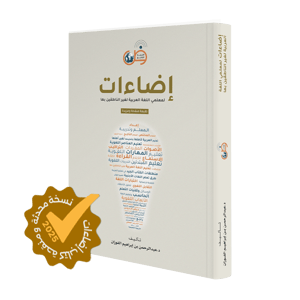
Insights
The book “Insights for Teachers of Arabic to Non-Native Speakers” is the teacher’s companion on the journey of teaching Arabic to non-native speakers. It combines scientific depth with practical simplicity, offering teachers distilled field experience in clear language and an inspiring style.
The book aims to empower teachers and develop their professional performance by presenting concise and focused discussions of key concepts in applied linguistics and language teaching, with a special emphasis on teaching Arabic to non-native speakers.
“Insights” is designed to be a practical guide that accompanies teachers step by step, helping them bring creativity into their classrooms and providing them with deeper vision and more effective methods to present Arabic to the world with confidence and mastery.

curricula
taught in


Book Features and Advantages
The series adopts modern methods and approaches in teaching foreign languages, while taking into account the unique characteristics of the Arabic language in its structure and style.

A Comprehensive and Integrated Reference
It combines both the theoretical and practical aspects of applied linguistics and language teaching, making it a comprehensive reference for teachers in the field.

Teacher Training and Professional Development
It provides the teacher with effective teaching methods and practical procedures for presenting language skills and managing lessons and exercises.

Suitable for all levels and experience
It is designed to benefit both beginner and experienced teachers, offering clear explanations and practical real-life examples that enhance understanding, facilitate application, and elevate teaching practice.
- It includes a comprehensive review and a self-assessment test with more than 260 questions to measure the teacher’s understanding of the book’s concepts.
- Its concise and clear style makes it easy and beneficial to read without unnecessary length or complexity.
- It focuses on teaching Arabic as a second language within the latest concepts of foreign language education.
- It is based on the author’s field experience and the collective expertise of the teacher-training team at Arabic For All.
- It helps teachers be creative in the classroom through practical models and hands-on guidelines for presenting skills and linguistic elements.

The book has been developed through multiple stages of updating and revision, and it is now available in its improved third edition.
Book Chapters
This chapter discusses the role of the teacher in teaching Arabic to non-native speakers, the qualities of a successful teacher, classroom management, and the unique nature of language-teaching classrooms. It also covers the difference between teaching Arabic to native speakers and non-native speakers, as well as the processes of language acquisition and learning.
This chapter explains the methods of teaching language elements (sounds, vocabulary, and structures), and then moves on to teaching the four language skills—listening, speaking, reading, and writing—using practical, applied techniques.
This chapter provides practical guidelines for teaching beginners and presents types of language exercises suitable for the early stages of learning, with a focus on simplifying the language and building the learner’s confidence.
This chapter reviews the issues found in Arabic language teaching textbooks for non-native speakers, analyzing their foundations, stages, and accompanying materials. It also discusses the most prominent foreign language teaching methods and their application in teaching Arabic.
This chapter focuses on language tests and their types, error analysis, and contrastive linguistics, in addition to modern educational tools and language games and their role in supporting the learning process.
This chapter addresses the objectives and stages of practical training, presenting applied components such as observation, lesson preparation, micro-teaching, and the mechanisms for implementing field practicum.
This chapter presents a set of practical models for delivering lessons and exercises, including presenting dialogues, vocabulary, sounds, structures, and the four language skills, serving as an applied guide for teachers in the classroom.
This chapter addresses the most prominent questions faced by teachers of Arabic to non-native speakers and provides scientific and educational insights that help them develop their performance and broaden their perspective in the educational field.
Watch the specialized teacher-development training course, built on the instructional content of the “Insights” book (Link).